
Blood chemistry analysis revealed significant differences in physiological health markers, particularly liver transaminase levels.
Clinical observations
The LPT10 group recorded the lowest values for aspartate aminotransferase (AST: 41.9 U/l) and alanine aminotransferase (ALT: 14.2 U/l) compared to both HFM (AST 69.5 / ALT 20.6) and LFM (AST 76.5 / ALT 24.6). From a nutritional perspective, this reduction in hepatic transaminase activity indicated that Peptitom’s high-quality peptide profile avoided the metabolic strain and inflammatory stress often associated with the high-inclusion plant proteins used in LFM formulations.
The apparent digestibility coefficient (ADC) data underscored the high bioavailability of the hydrolysate-supplemented diets. The presence of low-molecular-weight peptides in PEPTITOM likely enhanced feed solubility and reduced the digestive effort required by the fish. LPT10 recorded the highest values for ADCc and ADCe across all treatments, demonstrating total nutritional optimisation.
Internal health assessments confirmed that LPT10 inclusion significantly improved gut architecture and microbial balance.
Microbial composition
The LPT10 diet selectively modulated the gut flora, suppressing opportunistic pathogens such as Vibrio spp. while recording the highest counts of beneficial Lactobacillus spp. ( 0.29×10⁴ CFU/g). This shift was likely driven by the antimicrobial bioactive peptides present in the hydrolysate, which then promoted a probiotic-like environment.
Histomorphology
The absorptive surface area was significantly enhanced in the LPT10 group, which reached a villi height of 1064µm. This is a substantial improvement over the LFM control (805µm) and the HFM control (946µm), directly correlating with the higher ADC and improved nutrient utilization observed in this group.
Lipid metabolism and gene expression analysis
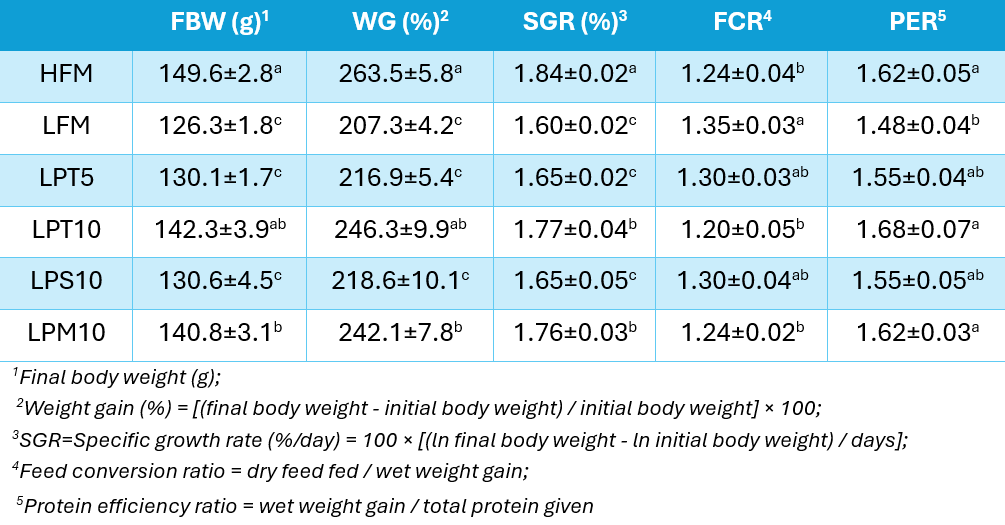
The study utilized qPCR to analyze pathways related to energy homeostasis. While core pathways ( FAS , CPT and PPAR ) remained stable, Peptitom significantly impacted fatty acid transport. With regards to FABP (fatty acid-binding protein), the expression was significantly upregulated in the LPT10 and LPM10 groups compared to the LFM control. This upregulation of FABP suggested that Peptitom actively optimised the transport and intracellular utilisation of lipids. This molecular enhancement explained the superior FCR (1.20) and overall improved metabolic efficiency of the fish.
Disease resistance: An Edwardsiella tarda challenge
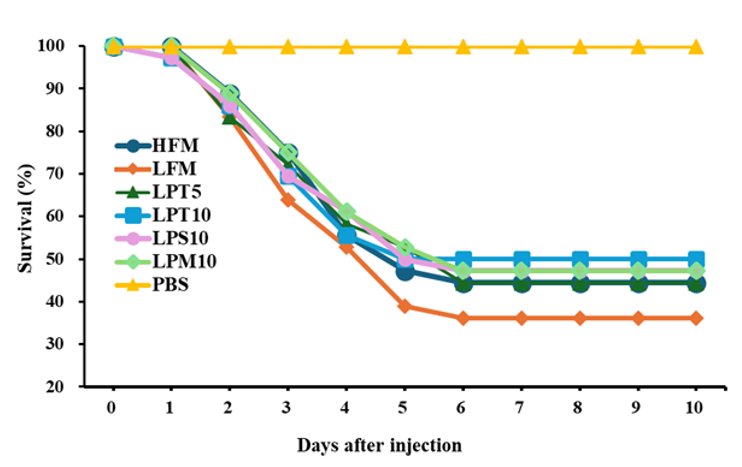
The 10-day bacterial challenge served as a functional validation of the improved immune and antioxidant parameters. The LPT10 group achieved the highest survival rate among all treatments. This superior resistance is a direct result of the synergistic effects of enhanced lysozyme and MPO activity, improved gut mucosal integrity and the immunomodulatory action of Peptitom’s bioactive peptides.
The results of this study confirmed that overall protein hydrolysates (Peptitom, Peptisalm, and Peptimar) served as highly effective functional ingredients that could successfully compensate for the reduction of fish meal in commercial diets. Of particular benefit is the shrimp protein hydrolysate with its immune boosting capacities. They successfully mitigate the negative impacts of fish meal reduction on growth, immunity and liver health.
The inclusion of 10% hydrolysate allows for the replacement of approximately 67% of the fishmeal (effectively reducing total FM from 30% to 10% of the diet) while maintaining growth performance comparable to HFM diets and significantly improving gut health, non-specific immunity and disease resistance.
Mirasha Hasanthi, is a Postdoctoral Researcher, Jeju University. Email: mirasha@jejunu.ac.kr
Paul Vincent is Marketing & Product Manager, Aquaproducts. Email: pvincent@aquaproducts.org
Thomas Levallois is Co-Founder, Aquaproducts. Email: tlevallois@aquaproducts.or